Blog · 9 min read
Shiva Pooja Vidhi: Simple Home Worship and Trimbakeshwar Anushthan
Reviewed by Acharya Krishnakant Shashtri · Updated 12 September 2026
A practical Shiva worship guide that clearly separates simple home devotion from formal Rudrabhishek and mantra anushthan.
Quick answer
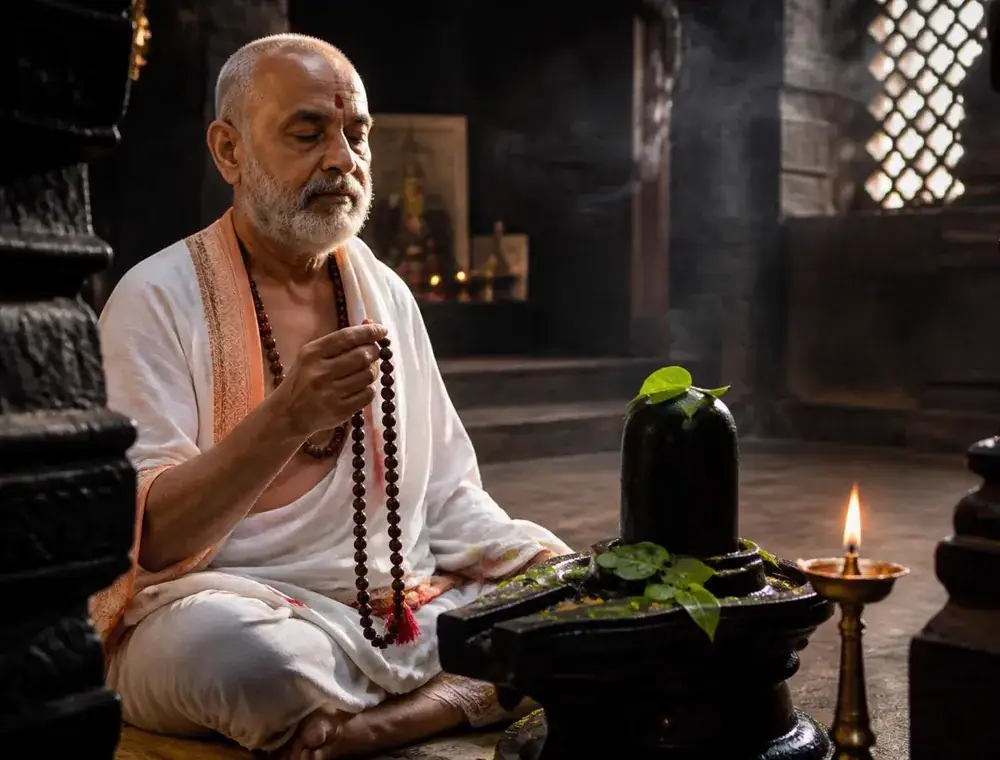
A simple Shiva Pooja at home needs no elaborate arrangement: clean the worship place, remember Ganesh, take a quiet sankalp, offer water to the Shiva Linga, place bilva leaves or flowers, chant Om Namah Shivaya and close with aarti or silent prayer. Rudrabhishek at Trimbakeshwar is a distinct priest-led ceremony using Sri Rudram and a formal sankalp.
The purpose of Shiva worship
Shiva is approached as the still awareness within change—as Mahadev, Rudra and Tryambaka. Household worship is therefore less about asking for a transaction and more about cultivating steadiness, restraint and surrender.
Traditional prayers may be offered during illness, transition or uncertainty, but puja should never replace medical, legal or financial care. The rite supports the devotee's inner and family life while practical responsibilities continue.
Simple Shiva Pooja vidhi at home
Use a stable, clean worship place. If there is a Shiva Linga, place it so offered water can be collected respectfully rather than spilled. Keep the procedure manageable enough to repeat.
- ◆Clean the place and wash before sitting
- ◆Begin with Ganesh smaran and state the sankalp
- ◆Offer water slowly; panchamrit is optional
- ◆Offer bilva leaves with the smooth side upward according to common practice
- ◆Chant Om Namah Shivaya or read Shiva Chalisa
- ◆Offer aarti, distribute prasad and clean the area
Offerings and what matters most
Water is the simplest abhishek. Milk, curd, ghee, honey and sugar form panchamrit where family tradition uses it, but large quantities are unnecessary. Flowers, bilva leaves and fruit should be clean and offered without waste.
Devotion is not measured by costly materials. If an item is unavailable, do not postpone prayer or substitute unsafe substances based on an online list.
Monday, Pradosh and Shravan
Monday is traditionally associated with Shiva, and Pradosh is observed around twilight on Trayodashi. Shravan and Mahashivratri are especially important periods. Yet no rule prevents simple daily worship on other days.
For a formal family anushthan, a current panchang and the family's circumstances are considered. Generic dates should not be treated as personalised muhurats.
When to choose Rudrabhishek
Choose Rudrabhishek when the intention specifically calls for Sri Rudram chanting, a formal abhishek and an Acharya-led sankalp. At Trimbakeshwar the service may be arranged in person or by proxy, with the scale selected honestly for the purpose.
Choose home Shiva Pooja when the goal is regular devotion. It is complete in its own setting and does not become lesser because no booking is involved.
Planning a visit from Nashik
Trimbakeshwar is in Nashik district and road time varies with traffic and festival crowds. Confirm temple access, reporting time and the precise ceremony location before travelling. Carry only the items requested; the Acharya can arrange the prescribed samagri when agreed in advance.
Key takeaways
- ◆Simple Shiva worship is open, practical and sufficient for daily devotion.
- ◆Water, attention and a sincere mantra matter more than expensive materials.
- ◆Rudrabhishek is a specific Vedic procedure, not merely another name for all Shiva worship.
- ◆Formal dates and counts should be selected for the actual sankalp.
Frequently asked questions
Related Dharmsetu anushthans
Rituals traditionally connected with Shiva Pooja Vidhi, performed at Trimbakeshwar.
Rudrabhishek Puja
Abhishek of the Jyotirlinga with the Sri Rudram, the highest Shiva worship.
Read more
Shiva Panchakshari Anushthan
Focused worship through the five sacred syllables of Om Namah Shivaya.
Read more
Mahamrityunjaya Jaap
The mantra of conquering death, chanted for healing and protection.
Read more