Blog · 10 min read
Kaal Sarp Shanti: The Shanti Vidhi, Muhurat and What Changes After It
Reviewed by Acharya Krishnakant Shashtri · Updated 2 September 2026
Kaal Sarp Dosh is diagnosed far more often than it exists. Here is what the Kaal Sarp Shanti vidhi involves at Trimbakeshwar, when it is performed, and what it is honestly meant to achieve.
Quick answer
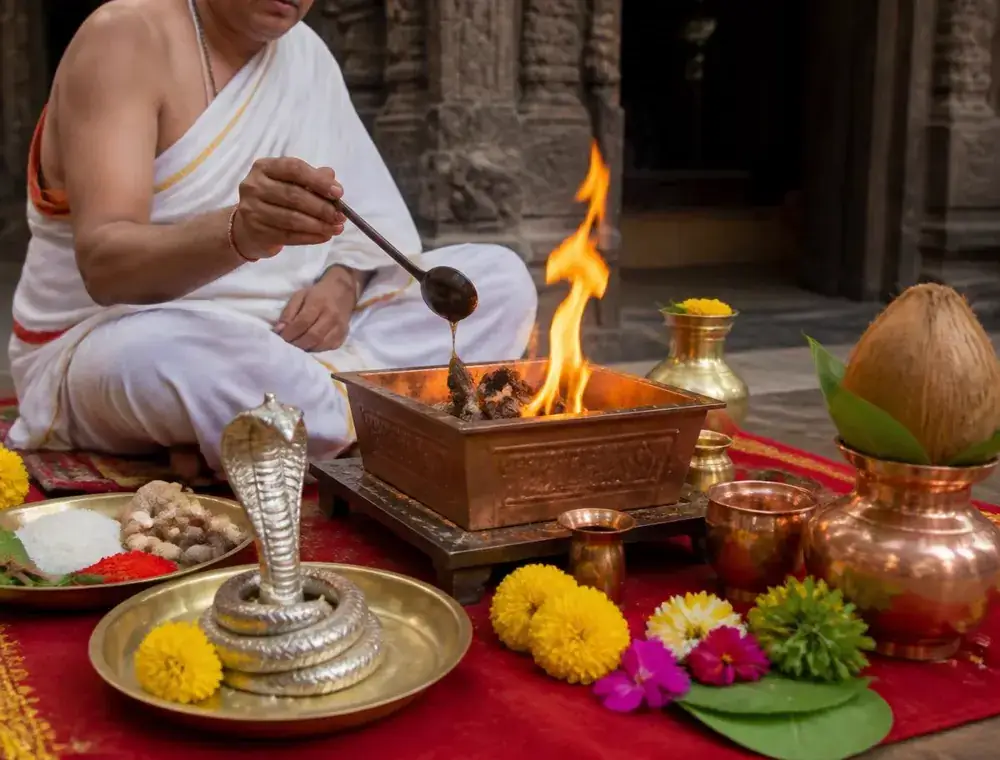
Kaal Sarp Shanti is performed when every principal graha in a kundli sits between Rahu and Ketu. The vidhi at Trimbakeshwar runs in one day: sankalp, Rahu–Ketu japa, Naag pratishtha and abhishek at the Kushavarta ghat, havan, brahmin bhojan and dana. Naag Panchami and Amavasya are the preferred muhurats, and the whole rite can be taken by proxy for families abroad.
What Kaal Sarp Yoga actually is
Rahu and Ketu are not physical bodies. They are the two points where the Moon's path crosses the ecliptic, and Vedic astrology treats them as an axis of unfinished karma rather than as ordinary planets. When the Sun, Moon, Mars, Mercury, Jupiter, Venus and Saturn all fall on one side of that axis, the chart is described as Kaal Sarp Yoga — the grahas are said to be held within the coil of the serpent.
The classics read it as a concentration of effort rather than a sentence. Life moves, but progress is described as arriving late, through more struggle than the person's effort deserves, and often in a single sudden release after years of pressure.
The twelve named yogas
Traditional practice names twelve forms, depending on which house holds Rahu. Each is read differently, and the remedial emphasis changes with it — which is why a blanket prescription is a warning sign.
- ◆Anant, Kulik, Vasuki and Shankhpal — Rahu in the 1st to 4th houses; identity, wealth, courage and domestic peace
- ◆Padma, Mahapadma, Takshak and Karkotak — Rahu in the 5th to 8th; children, health, marriage and longevity
- ◆Shankhachur, Ghatak, Vishdhar and Sheshnag — Rahu in the 9th to 12th; fortune, career, gains and expenditure
How the dosh is confirmed — and how often it is not
A confirmed Kaal Sarp Yoga requires all seven grahas within the axis. If even one planet falls outside, the yoga does not form in its complete sense; the chart may show a partial or aanshik pattern, which the tradition treats far more mildly.
Free calculators cannot make that distinction well, and many report the dosh on any chart with a crowded Rahu side. Before any anushthan is booked, the Acharya checks the exact degrees of Rahu and Ketu, the running mahadasha and antardasha, and whether the person's actual life pattern matches what the yoga would produce.
The Kaal Sarp Shanti vidhi at Trimbakeshwar
The anushthan is completed in one day and follows a fixed sequence. Nothing in it is improvised.
- ◆Snan and sankalp in the name, gotra and nakshatra of the yajman
- ◆Ganesh puja, Kalash sthapana and Punyahavachan
- ◆Rahu and Ketu graha japa, with the avartan count fixed by the chart
- ◆Naag–Naagin pratishtha in silver or panchdhatu, followed by Rudrabhishek of the Trimbakeshwar linga
- ◆Havan with the prescribed samidha and purnahuti
- ◆Naag visarjan at Kushavarta, brahmin bhojan and dana
Choosing the muhurat
Naag Panchami in Shravan is the traditional first choice, since the day is itself dedicated to the serpent deities. Amavasya, Nag Chaturthi and the Panchami tithi of either paksha follow.
There is no need to wait a year for one of those dates. Where the family's circumstances require it, the Acharya selects a muhurat by weighing the tithi, nakshatra and the yajman's dasha — a correct rite on a valid day is worth more than a delayed rite on a famous one.
What changes after the shanti — stated honestly
The tradition does not promise that obstacles disappear. What it describes is a settling: the sense of running into the same wall repeatedly eases, and effort begins to convert into result at a more ordinary rate.
Families most often report clarity rather than fireworks — a decision that had been stuck for years finally moves. That is the scale on which the shastra speaks, and it is the only claim an honest Acharya should make.
Cost, proxy sankalp and travel
Dakshina varies with the japa count and the scale of the havan, and it is told in full before the date is fixed. Nothing is added on the day of the ritual.
If the yajman cannot travel, the sankalp is taken by proxy in their name and gotra, with the family joining over video and receiving the complete photo-video record, prasad and the tirth from the abhishek. Stay and darshan assistance is arranged for families arriving from outside Nashik.
Frequently asked questions
Related Dharmsetu anushthans
Rituals traditionally connected with Kaal Sarp Shanti, performed at Trimbakeshwar.